
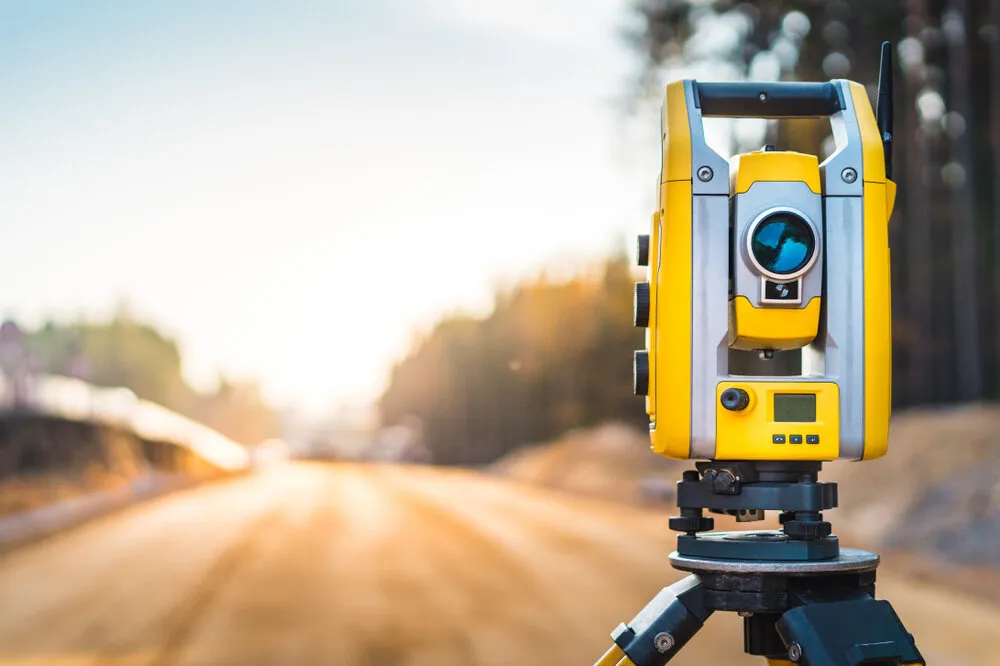
Surveying is one of the most critical processes in any construction project. Before construction begins, engineers must understand the terrain, elevation differences, distances between points, and the overall layout of the site. Accurate measurements ensure that buildings, roads, bridges, and other structures are constructed exactly as planned. Among the various surveying techniques used in civil engineering, Tacheometric Surveying stands out as a fast and efficient method for determining distances and elevations.
Tacheometric Surveying is widely used in construction and topographic mapping because it allows surveyors to measure horizontal distances and elevation differences without the need for direct measurement using chains or tapes. Instead, it relies on optical instruments and angular observations to calculate distances and levels. This technique significantly speeds up the surveying process, particularly in challenging terrains where traditional surveying methods may be difficult or time-consuming.
This article explores the concept of Tacheometric Surveying, how it works, its principles, methods, advantages, and why it plays an important role in modern construction projects.
Understanding Tacheometric Surveying
Tacheometric Surveying is a method of angular surveying in which horizontal distances and vertical elevations are determined using optical instruments rather than direct measurements. The technique uses a specialized instrument known as a tacheometer, which is similar to a theodolite but designed for rapid distance measurement.
In simple terms, Tacheometric Surveying allows surveyors to calculate the position of points on the ground by observing angles and staff readings through a telescope. This method eliminates the need for traditional tools such as chains or measuring tapes and therefore speeds up the survey process significantly.
The technique is especially useful when working in areas where direct measurement is difficult, such as:
- Hilly or mountainous terrain
- Forested regions
- Rivers or water bodies
- Uneven ground surfaces
- Large construction sites
By using optical calculations and trigonometric relationships, Tacheometric Surveying enables surveyors to quickly determine both horizontal distances and differences in elevation between points.
Principle of Tacheometric Surveying
The working principle of Tacheometric Surveying is based on geometry and trigonometry. The method relies on the relationship between the distance of an object and the angle subtended by it when viewed through a telescope.
In this technique, a leveling staff (called a stadia rod) is placed vertically at the point to be measured. The surveying instrument contains two horizontal lines called stadia hairs. When the surveyor observes the staff through the telescope, these hairs intercept a portion of the staff known as the staff intercept.
The key concept behind Tacheometric Surveying is that the distance between the instrument and the staff is directly proportional to the staff intercept observed through the telescope.
The commonly used formula is:
Distance = ks + c
Where:
k = multiplying constant (usually 100)
s = staff intercept
c = additive constant
Using this formula along with the measured vertical angle, surveyors can determine:
- Horizontal distance between points
- Difference in elevation
- Reduced levels of ground points
This principle allows accurate measurements to be obtained quickly without physically measuring long distances on the ground.
Instruments Used in Tacheometric Surveying
Several specialized instruments are required to perform Tacheometric Surveying effectively. These instruments work together to capture the necessary angular and staff readings.
The main instruments include:
-
Tacheometer
A tacheometer is a modified theodolite designed specifically for tacheometric measurements. It contains stadia hairs in the telescope that help determine the staff intercept.
-
Stadia Rod
The stadia rod is a graduated staff used to measure the intercepted length between the stadia hairs. It is similar to the leveling staff used in leveling operations.
-
Tripod Stand
The surveying instrument is mounted on a tripod to ensure stability and accurate observation.
-
Leveling Tools
Bubble levels and leveling screws are used to ensure that the instrument is perfectly horizontal during measurement.
These instruments allow surveyors to obtain accurate measurements with minimal field effort.
Methods of Tacheometric Surveying
Tacheometric Surveying can be carried out using different methods depending on the equipment and the level of accuracy required. The most commonly used methods are explained below.
-
Stadia Method
The stadia method is the most widely used technique in Tacheometric Surveying. It uses two fixed horizontal lines called stadia hairs inside the telescope of the instrument.
When the surveyor observes the stadia rod through the telescope, the upper and lower stadia hairs intercept a portion of the staff. The difference between these readings is called the staff intercept.
Using this intercept value and the stadia constants, the horizontal distance between the instrument and the staff station can be calculated.
The stadia method is popular because:
- It provides quick measurements
- It requires minimal fieldwork
- It is suitable for topographic surveys
-
Tangential Method
The tangential method of Tacheometric Surveying involves measuring two vertical angles to two points on the staff.
In this method:
- Two angular observations are taken
- The distance is calculated using trigonometric relationships
Although this method can be performed with a standard theodolite, it is generally slower than the stadia method because it requires more observations.
-
Subtense Method
The subtense method uses a fixed bar known as a subtense bar placed at the point being measured. The surveyor measures the angle subtended by the bar using a theodolite.
From this measured angle and the known length of the bar, the distance can be calculated using trigonometry.
This method is particularly useful for long-distance measurements.
Procedure of Tacheometric Surveying
The procedure for conducting Tacheometric Surveying generally involves the following steps:
- Select the survey station and set up the instrument on a tripod.
- Level the instrument carefully to ensure accurate readings.
- Measure the height of the instrument from the ground.
- Place the stadia rod vertically at the target point.
- Observe the staff through the telescope and record the top, middle, and bottom readings.
- Measure the vertical angle using the instrument.
- Calculate the staff intercept by subtracting the bottom reading from the top reading.
- Use the tacheometric formula to calculate horizontal distance and elevation difference.
This process allows surveyors to collect a large amount of survey data quickly across a wide area.
Advantages of Tacheometric Surveying
Tacheometric Surveying offers several advantages compared to traditional surveying methods. These benefits make it particularly valuable for large construction and infrastructure projects.
Some major advantages include:
- Faster data collection – Measurements can be taken quickly without the need for chaining or taping.
- Suitable for difficult terrain – It works well in mountainous, forested, or uneven areas.
- Reduced manpower requirement – Only a few personnel are needed to conduct the survey.
- Cost efficiency – Since fieldwork is faster, the overall surveying cost is reduced.
- Simultaneous measurement – Horizontal distances and elevation differences can be determined at the same time.
- Useful for contour mapping – It is widely used for preparing topographic maps and contour plans.
Because of these advantages, Tacheometric Surveying is commonly used in large-scale civil engineering projects.
Limitations of Tacheometric Surveying
Despite its benefits, Tacheometric Surveying also has certain limitations that must be considered.
Some limitations include:
- It may not provide the same level of precision as advanced electronic instruments.
- Accuracy can be affected by atmospheric conditions.
- The method requires trained surveyors to interpret the readings correctly.
- Long distances may introduce small calculation errors.
However, these limitations are often manageable, especially when the method is used for preliminary surveys or topographic mapping.
Applications of Tacheometric Surveying in Construction
Tacheometric Surveying is widely used in construction and civil engineering projects. Its ability to quickly measure both horizontal distances and elevations makes it particularly valuable during the planning and design phases.
Some key applications include:
-
Topographic Surveys
Tacheometric Surveying is commonly used to create topographic maps that show the natural features of land, including slopes, hills, and valleys.
-
Road and Railway Alignment
Surveyors use Tacheometric Surveying to determine the alignment of roads, highways, and railway tracks, particularly in hilly areas.
-
Bridge and Tunnel Projects
In projects where direct measurement is difficult, such as across rivers or valleys, Tacheometric Surveying provides an efficient solution.
-
Contour Mapping
Contour maps are essential for understanding the elevation profile of a site. Tacheometric Surveying helps engineers generate these maps quickly.
-
Hydrographic Surveys
The method is also used in surveying water bodies, including rivers, lakes, and reservoirs.
Importance of Tacheometric Surveying in Modern Construction
Construction projects today demand speed, accuracy, and efficiency. Surveying plays a vital role in ensuring that projects are executed according to design specifications.
Tacheometric Surveying helps engineers collect large amounts of survey data in a short time, which is essential during the early stages of project planning. It allows surveyors to work effectively in areas where traditional measurement techniques would be slow or impractical.
Even though modern instruments such as total stations and GPS technology have become popular, the fundamental principles of Tacheometric Surveying continue to influence modern surveying methods. Many modern instruments still incorporate similar optical measurement concepts.
For construction engineers, understanding Tacheometric Surveying provides valuable insight into traditional surveying techniques and the evolution of modern measurement technologies.
In a nutshell
Tacheometric Surveying is an important surveying technique that enables engineers and surveyors to measure horizontal distances and elevation differences quickly using optical instruments. By relying on angular observations rather than direct measurement, the method significantly reduces the time and effort required to collect field data.
This surveying technique is particularly useful in difficult terrains where traditional methods such as chain surveying are impractical. Through methods like the stadia system, tangential method, and subtense method, Tacheometric Surveying provides reliable data for topographic mapping, contour planning, road alignment, and many other construction-related applications.
Although modern technologies like total stations and satellite-based surveying systems have improved the accuracy and efficiency of field measurements, the principles behind Tacheometric Surveying remain fundamental to the field of surveying. Understanding this technique helps engineers appreciate the evolution of surveying methods and ensures better planning and execution of construction projects.
Subscribe to my channel on YouTube to gain access to a wealth of knowledge and expertise that can elevate your understanding of Real Estate, project management concepts, & Construction.
Related Articles: Construction